
For sales teams
One pipeline the whole team can trust.
Shared records, clear ownership, and reporting that shows what is really happening — without turning your CRM into a surveillance tool or a weekly data-entry tax.
No credit card required · Set up in minutes · AUD pricing
The situation
What usually goes wrong.
If none of this sounds like you, bizzMate may not be solving a problem you have — and we would rather you found that out here.
Everyone has their own version of the truth
One person's spreadsheet, another's notebook, a third's inbox. The forecast is whatever the loudest person said in Monday's meeting.
Handovers lose the relationship
Someone goes on leave, changes role or leaves the business, and the context goes with them. The customer notices immediately.
The pipeline review is archaeology
Half the meeting is spent working out what state each deal is actually in, rather than deciding what to do about it.

Sales teams
Everyone working from the same picture.
Ownership, history and next steps live on the record, so a handover is a link rather than a conversation someone has to remember.
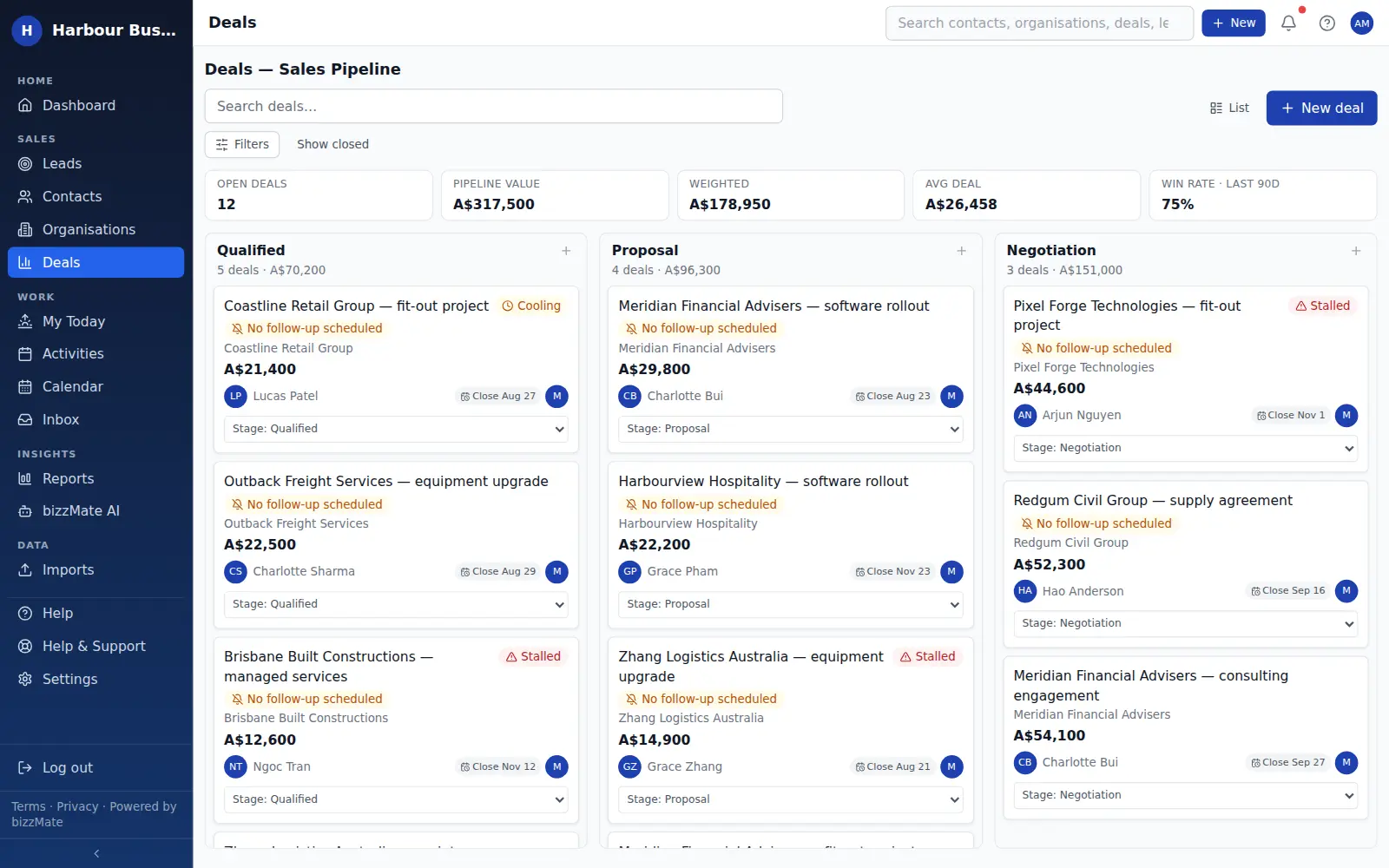
A shared board that stays current
Because moving a deal is one drag, the pipeline reflects reality rather than the last time someone did a tidy-up. Each column carries its deal count and value, so the shape of the pipeline is visible before anyone opens a record.
Above the board: open pipeline, probability-weighted pipeline, average deal value and win rate over the last ninety days. Those four figures replace most of a status meeting.
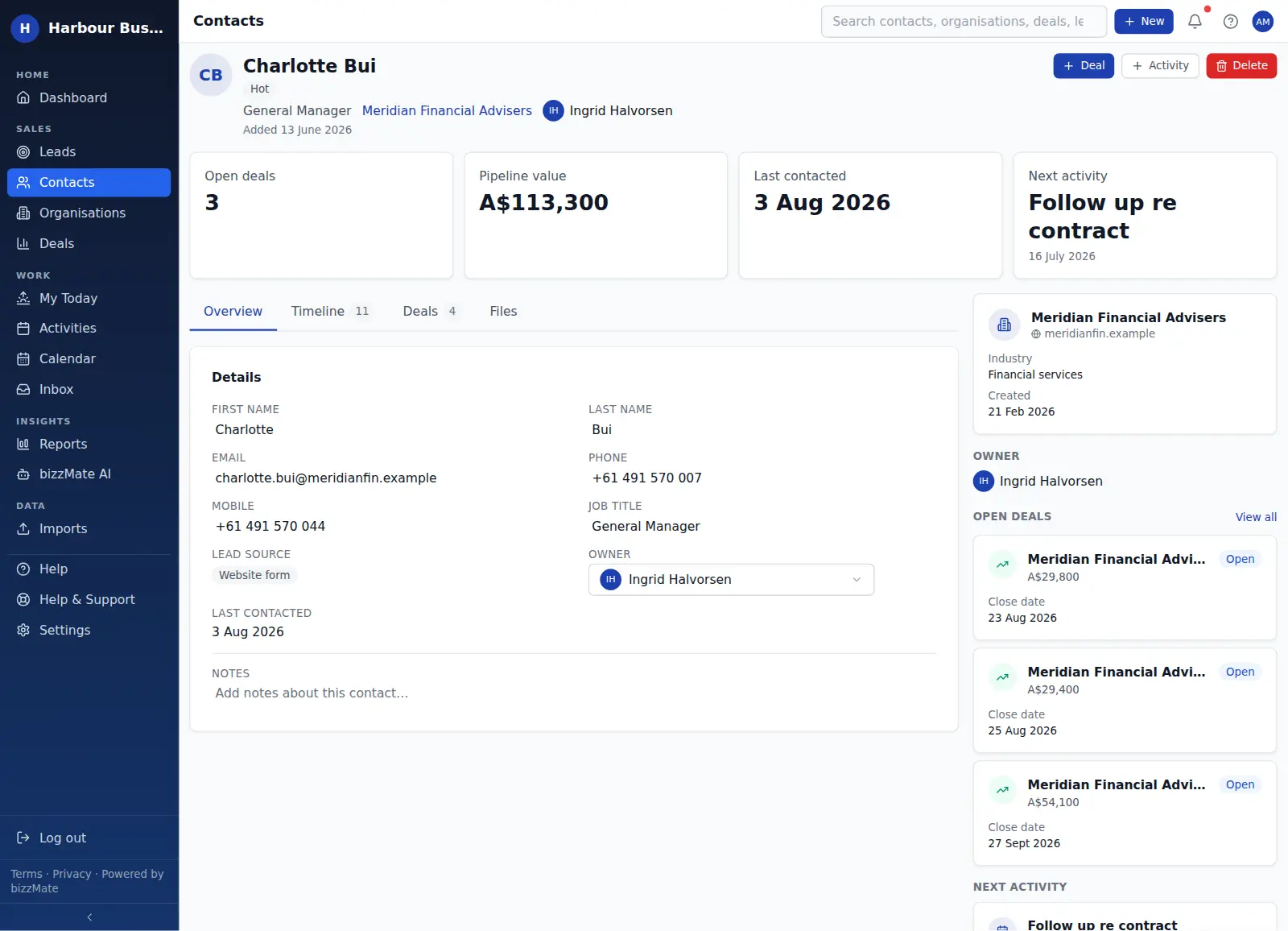
Ownership that makes handovers survivable
Contacts, organisations, deals and activities each have an owner, and admins can reassign them when someone's role changes. The timeline stays with the record, so whoever picks it up inherits the whole relationship rather than a name and a phone number.
Activities can be assigned to a colleague, so the person who spots the follow-up is not necessarily the person who has to do it.
Reporting per person, without theatre
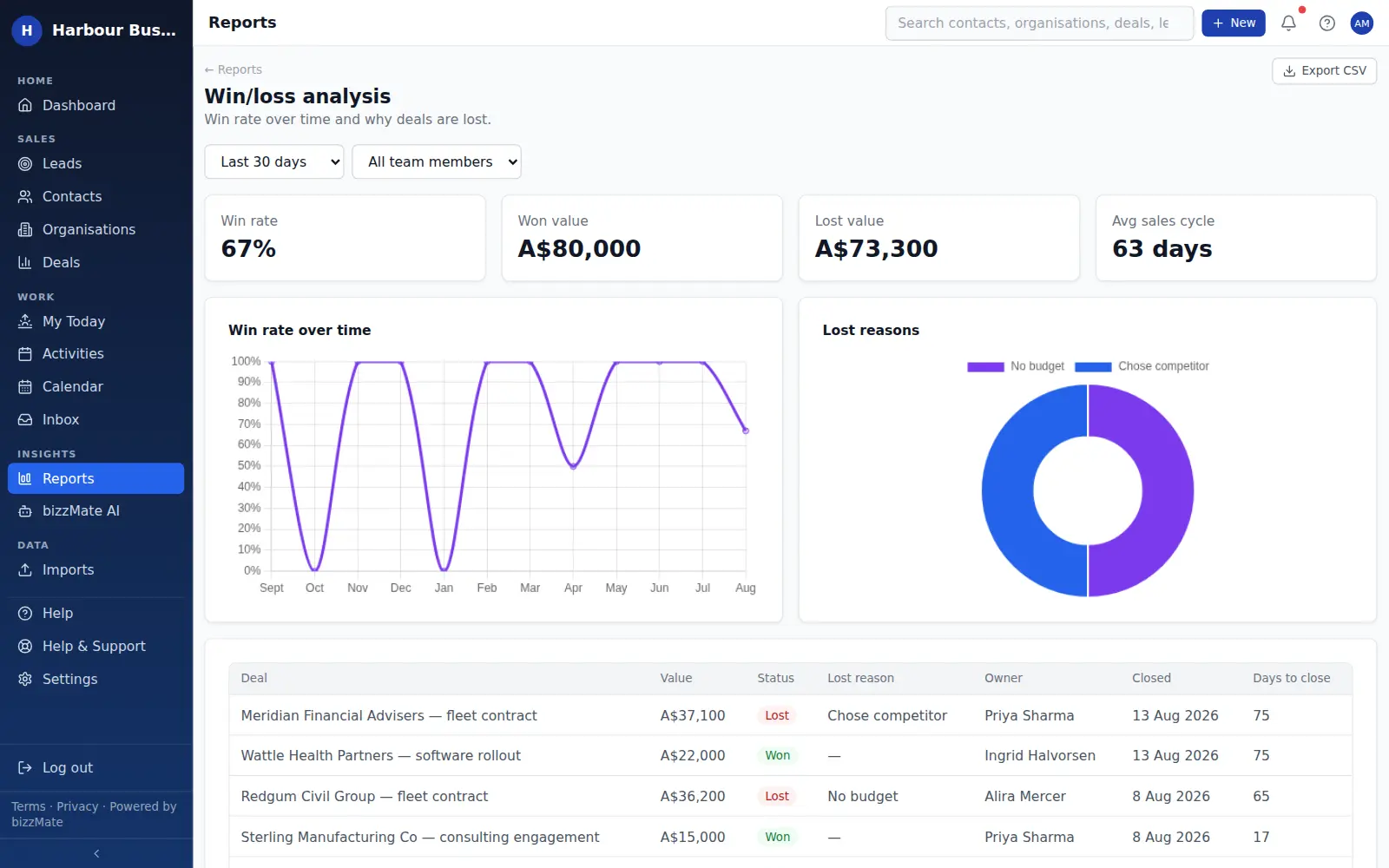
Owners and admins can filter every report by owner and see a team view of win rate and activity. Members see their own performance, and that boundary is enforced by the API rather than by hiding a menu item.
Because losses record a reason, the win/loss report shows patterns instead of anecdotes — which is a far more useful thing to coach against.
Attention signals instead of nagging
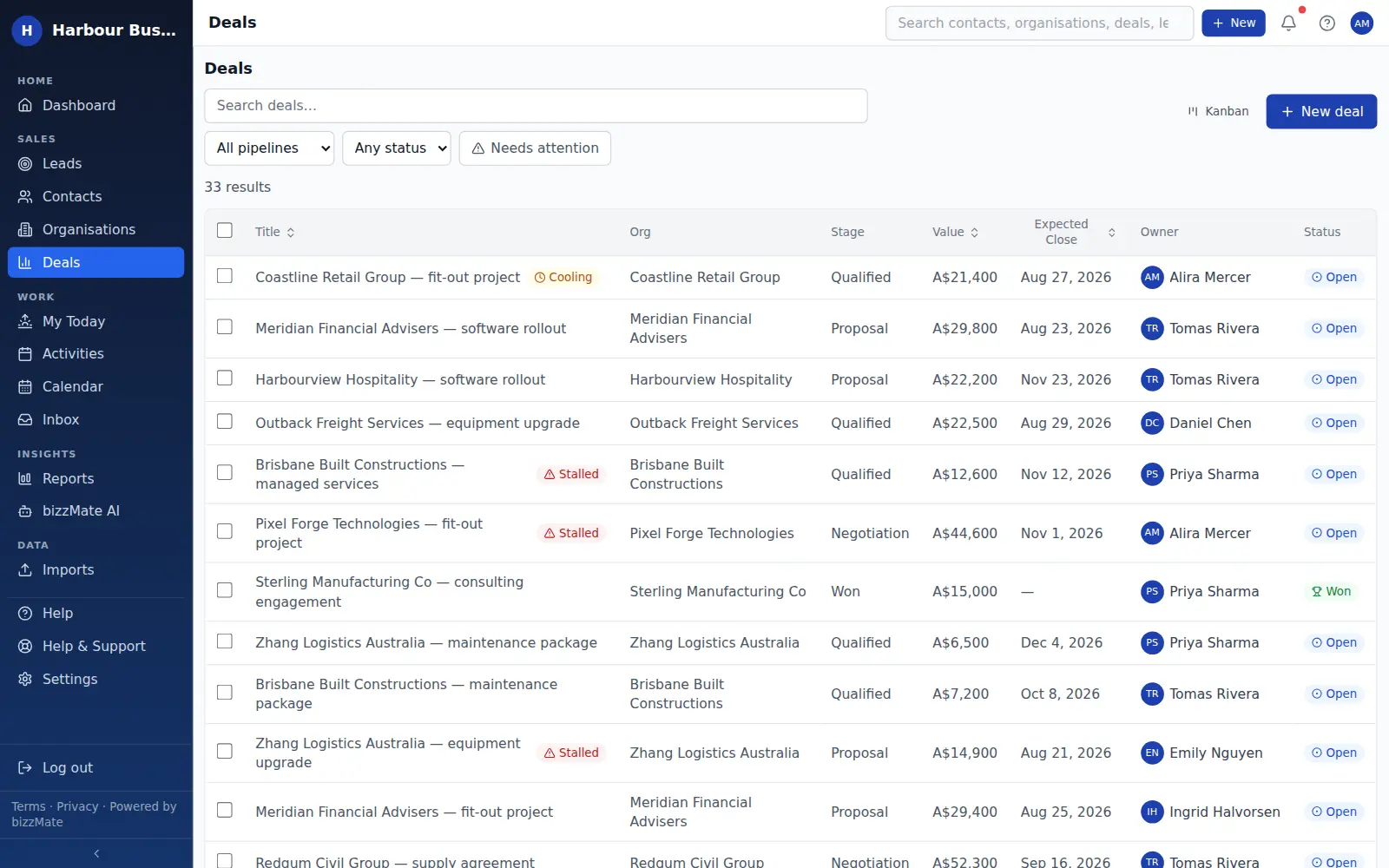
bizzMate flags open deals with no recent activity and open deals with no follow-up scheduled. Both come from real records, not from a rule someone configured and forgot.
That gives a sales lead a concrete weekly list — deals that need a decision — rather than a general instruction to update the CRM.
What changes
What you should expect.
Concrete outcomes, not a promise about revenue growth we have no way to make.
- A forecast built from the same records everybody works in
- Deals that cannot silently go quiet
- Handovers that take ten minutes of reading, not a meeting
- Coaching conversations grounded in recorded loss reasons
- Permissions the server actually enforces
Frequently asked questions
- How many people can share a workspace?
- Solo is a single user; Pro supports up to 25; Business removes the plan-level cap on how many people you can add, though each active user is still billed at the Business rate. You pay per person with access, and deactivating someone frees their seat. Solo is A$10, Pro is A$25 and Business is A$45 per user, per month.
- Can I stop members seeing each other's customers?
- Yes. Owners and admins can set each record type to private, so only the record's owner and admins can see it. Public visibility is the alternative if you want a genuinely shared book.
- Does bizzMate track how much my team is working?
- It reports the activity that has been logged and the outcomes of deals. It does not monitor screens, keystrokes or time. The reports exist to answer "is the process working", not to police people.
- Can two people work the same account?
- Yes. An organisation can hold many contacts and many deals with different owners, and the account timeline aggregates activity across all of them.
Your customers are moving.
Your CRM should keep up.
Start organising your contacts, deals and follow-ups in one clear workspace.
No credit card required.